
Beyond Faith: The Role Of Religion In The Lives Of Indians And Malaysians For many Indians and Malaysians, faith is introduced long before we fully understand it. It is woven into family life, celebrations, traditions, values and the rhythms of everyday living.
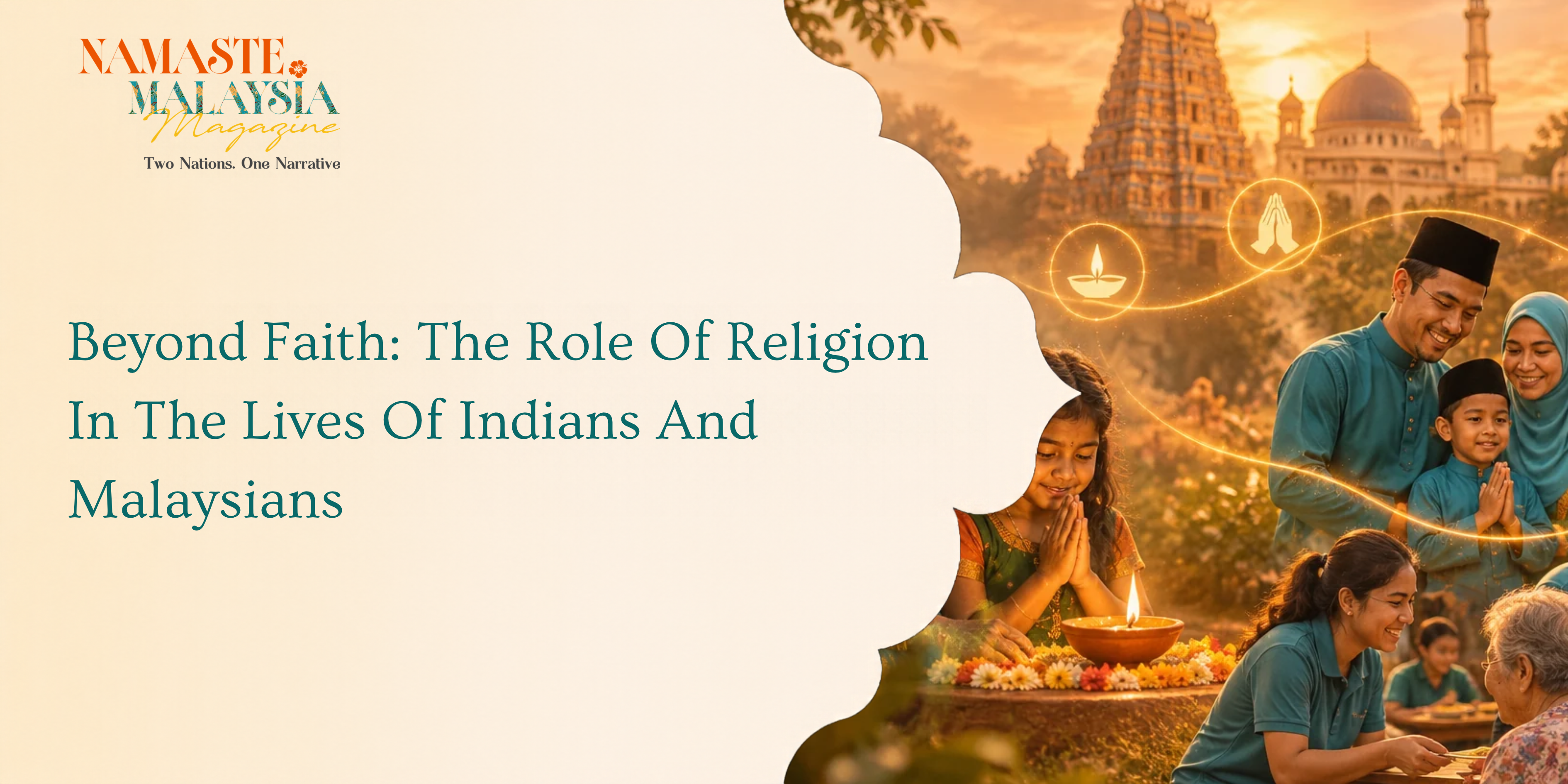
From the traditions we inherit to the prayers we whisper, faith often shapes our lives in ways we don't fully realise.
We may not remember our first prayer.
We may not remember who first taught us to fold our hands, bow our heads, light a lamp, sit quietly, visit a sacred place or whisper words of hope. But somewhere in our childhood, these little moments became part of us.
Perhaps it was a grandmother who never began her morning without prayer. A mother who quietly wished for her children's happiness. A father who paused before an important journey. Or a family that gathered during celebrations, not simply to observe a tradition, but to give thanks for being together.
For many Indians and Malaysians, faith is introduced long before we fully understand it. It is woven into family life, celebrations, traditions, values and the rhythms of everyday living.
And as we grow older, we begin to realise that religion is not always about the rituals we see. Sometimes, its greatest influence lies in the things we cannot see.
Faith begins at home
Before we understand religion, we often experience it.
We see it in the habits of our parents and grandparents. In the festivals our families celebrate, the prayers they recite, the traditions they preserve and the values they try to pass down.
As children, we may simply follow along. We may not understand why certain days are important, why particular rituals are observed, or why our elders insist on doing things a certain way.
But years later, something changes.
We find ourselves repeating a familiar prayer. Preparing for a celebration in the way our parents once did. Remembering words of wisdom from a grandparent. Or doing something our elders taught us, without even realising where the habit came from.
Perhaps that is how faith and tradition survive — not always through formal lessons, but through memories, love and the quiet influence of those who came before us.
In both India and Malaysia, where family relationships and traditions hold an important place in many people's lives, these practices can become more than rituals. They become connections to our roots, our identity and the people who shaped us.
And sometimes, when the people who taught us these traditions are no longer around, the rituals become even more precious.
We are no longer simply performing something we were taught.
We are remembering someone.
The prayers we never say out loud
There are prayers we say openly.
And then there are the ones nobody else hears.
The prayer whispered when a loved one is ill. The one offered before a child sits for an important examination. The silent plea when a family is going through financial difficulties. The hope that a relationship can heal, that a difficult situation will pass, or that someone we love will find their way home safely.
These prayers are rarely grand.
They are personal. Vulnerable. Sometimes desperate. Sometimes filled with gratitude.
A person may appear perfectly composed on the outside, attending meetings, going to work, laughing with friends and carrying on with life as usual. Yet somewhere within, there may be a prayer for strength, a plea for guidance or a hope they have not dared to share with anyone.
Perhaps that is one of the most deeply human aspects of faith.
We do not always turn to prayer because life is falling apart. Sometimes we turn to it because we are grateful. Because something wonderful has happened. Because we have been given another chance. Because someone we love has recovered. Because a door we thought was closed has unexpectedly opened.
And sometimes, we pray without asking for anything at all.
We simply say thank you.
In a world that encourages us to explain everything, solve everything and remain strong at all times, faith can offer a place where we do not have to pretend.
We can be afraid.
We can be uncertain.
We can be hopeful.
We can simply be ourselves.
Sacred spaces, human stories
Walk into a place of worship in India or Malaysia and you may notice the architecture, the sounds, the rituals, the fragrance, the colours or the quietness.
But look a little closer, and there are stories everywhere.
Someone has come to give thanks after a difficult year. Someone is seeking comfort following a loss. Someone is asking for guidance before making a life-changing decision. Someone has brought their child, hoping to pass on something meaningful. Someone has simply come because this is the place where they feel most at peace.
For many, sacred spaces are not merely buildings. They are places where life's burdens can be set down, even if only for a few moments.
They are also places of community.
People gather, celebrate milestones, support one another, contribute to charitable causes, care for those in need and find companionship. In moments of joy and sorrow, these communities can become an important source of human connection.
The significance of these places is not always found in what happens during a ceremony. Sometimes it is in the quiet conversation afterwards. The meal shared with someone who has little. The volunteer who turns up every week. The elderly person who finds company. The stranger who receives help without being asked to explain their circumstances.
Behind every sacred space are human beings carrying stories that we may never know.
And perhaps that is what makes these places so meaningful — they remind us that we are not meant to navigate every chapter of life alone.
When faith becomes action
Faith is often associated with prayer, rituals, traditions and places of worship.
But perhaps one of its most beautiful expressions is what happens when we leave those places.
When someone feeds a hungry person.
When a family helps another family through a difficult period.
When a person gives their time to care for the elderly.
When someone visits a lonely neighbour, forgives an old hurt, offers comfort to a grieving friend or helps another person without expecting recognition.
These acts may never make headlines. They may not be accompanied by grand declarations. They may not even be seen by anyone else.
But they matter.
Across India and Malaysia, acts of generosity and community service take place every day — often quietly, through families, neighbourhoods, community organisations and people who simply believe that someone else's hardship deserves their attention.
Perhaps this is where the influence of faith becomes most visible, not in what we profess, but in how we treat the people around us.
Kindness does not need an audience.
Compassion does not need a certificate.
And helping another human being does not need to come with a photograph.
Sometimes, the most meaningful thing we can do is make another person's life a little easier.
As we grow older, we begin to understand
Perhaps our relationship with faith changes as we journey through life.
When we are young, we may be introduced to it through our families.
As adults, we may turn to it during difficult decisions, responsibilities, disappointments and uncertainty.
As we grow older, perhaps we begin to appreciate it differently. We become more conscious of time. We experience loss. We understand that not everything can be controlled, planned or explained. We become more grateful for the ordinary things we once took for granted.
A healthy day.
A family meal.
A phone call from someone we love.
The opportunity to wake up and begin again.
We may discover that the questions we once asked are no longer the same. Perhaps we ask less about what we want from life and more about what life has already given us.
Perhaps we become less concerned about having all the answers and more interested in finding peace with the questions.
And perhaps, somewhere along the way, faith becomes less about asking for more and more about learning to appreciate what is already here.
Beyond faith, there is the way we live
India and Malaysia are home to people of different beliefs, traditions and ways of practising their faith. Their stories are unique, their experiences personal and their journeys deeply individual.
Yet, behind these differences are familiar human experiences.
The love of a parent for a child.
The hope that tomorrow will be better.
The gratitude for a second chance.
The desire to live a meaningful life.
The need for comfort when we lose someone.
The instinct to help when another person is struggling.
Perhaps the role of faith is not always measured by how much we know, how many rituals we observe or how often we speak about it.
Perhaps it is also reflected in the patience we show, the compassion we offer, the gratitude we carry and the kindness we leave behind.
Because ultimately, beyond the prayers we whisper, the traditions we inherit and the sacred spaces we visit, there is a question that matters to all of us:
Are we becoming better human beings?
Perhaps that is a question worth carrying with us — long after the prayers have ended, the celebrations are over and we have returned to the ordinary routines of life.
And perhaps the most beautiful expression of faith is not always found in what we say when we close our eyes.
Perhaps it is found in what we do when we open them.
Let's talk about it
Note: What is one tradition, prayer, lesson or act of kindness passed down to you that has stayed with you throughout your life — and perhaps means even more to you today than it did when you were younger?
Some of the most beautiful stories are not found in books. They are the ones we carry within us.
Namaste Malaysia Magazine — connecting people and culture between Malaysia and India!