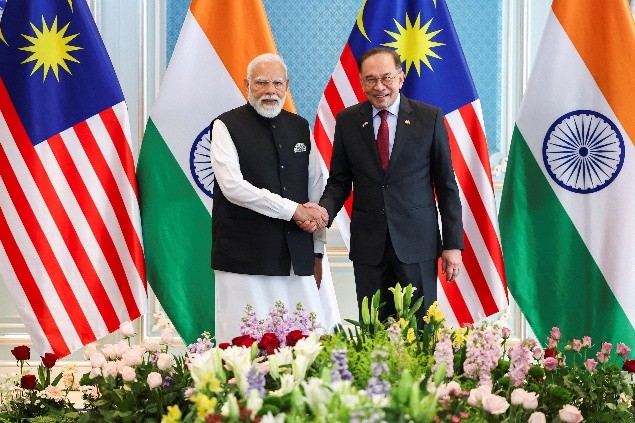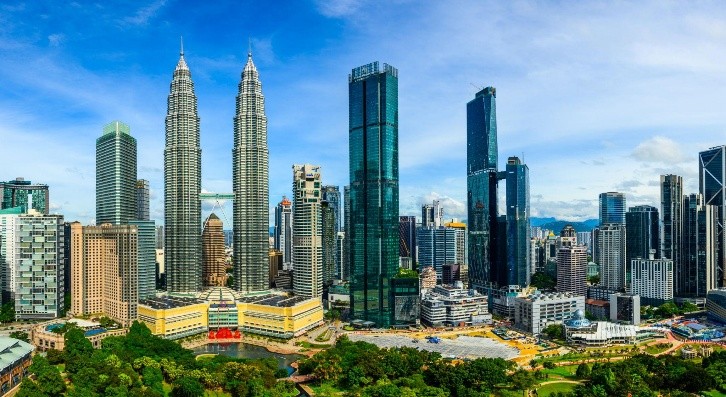
Why India And Malaysia Need Each Other India and Malaysia may be separated by the Bay of Bengal, but their relationship has never been defined by geography alone.

Two nations. Complementary strengths. And a partnership with the potential to shape the future.
What happens when one country brings scale, technology and a rapidly expanding market, while another offers strategic access to Southeast Asia, a multicultural business environment and strong regional connections?
AN OPPORTUNITY!
India and Malaysia may be separated by the Bay of Bengal, but their relationship has never been defined by geography alone. Centuries of trade, migration, culture and shared traditions have created connections that continue to influence how people live, work and do business today.
But there is a bigger story waiting to be told.
As the global economy changes, supply chains evolve and businesses look beyond traditional markets, India and Malaysia have an opportunity to become much more than friendly trading partners.
They can become strategic partners in each other's growth.
And perhaps the question is no longer simply what these two countries have in common, but what they can achieve together that neither could accomplish as effectively alone.
Two different strengths. One big opportunity.
India is one of the world's largest economies, with a vast domestic market, a young workforce, a growing technology sector and an increasingly influential entrepreneurial ecosystem.
Its strengths span information technology, pharmaceuticals, manufacturing, engineering, financial services, digital innovation and research.
Malaysia, meanwhile, occupies a strategic position in Southeast Asia. It has an established manufacturing base, strong electrical and electronics capabilities, developed infrastructure, a sophisticated financial sector and access to the wider ASEAN market.
Malaysia is also home to a multicultural population with strong connections to different parts of Asia, including India.
These strengths are not identical. That is precisely what makes the relationship interesting.
Indian businesses looking to expand into Southeast Asia can consider Malaysia as a regional base. Malaysian companies looking for access to India's large and expanding market can explore opportunities through Indian partners.
The relationship does not have to be a competition over who is stronger.
It can be a partnership in which both countries bring something valuable to the table.
The business connection: beyond buying and selling
Trade is often the first thing people associate with international partnerships.
India and Malaysia already have an established trading relationship, covering products such as palm oil, petroleum products, chemicals, machinery, electronics, pharmaceuticals and agricultural commodities.
But the next stage of cooperation should go beyond exporting and importing.
Imagine:
- A Malaysian manufacturing company partnering with an Indian technology firm to develop smarter production systems.
- An Indian pharmaceutical company working with Malaysian partners to strengthen regional manufacturing and distribution.
- A Malaysian engineering company collaborating with Indian infrastructure specialists.
- An Indian technology business using Malaysia as a platform to serve customers across ASEAN.
These are not simply commercial transactions. They are opportunities to combine expertise, investment, talent and market access.
For small and medium-sized enterprises, the possibilities are equally interesting.
A Malaysian food producer could explore India's growing consumer market. An Indian digital services company could work with Malaysian businesses to support their digital transformation. A family-owned business in either country could find a distributor, investor or strategic partner across the border.
The next great cross-border success story may not necessarily begin in a boardroom. It could begin with a conversation between two entrepreneurs who recognise an opportunity neither had considered before.
Technology: building the next generation of opportunities
If there is one area where India and Malaysia can deepen their cooperation, it is technology.
India has developed a substantial technology ecosystem, with strengths in software development, artificial intelligence, fintech, cybersecurity, digital platforms and engineering talent.
Malaysia is also advancing its digital economy, investing in artificial intelligence, semiconductor capabilities, data centres, digital infrastructure and technology-driven industries.
There is considerable scope for collaboration.
India's technology talent and innovation ecosystem could complement Malaysia's ambition to strengthen its position as a regional digital and semiconductor hub.
Malaysian businesses could benefit from Indian expertise in software development, digital transformation and technology services.
At the same time, Indian companies could use Malaysia as a base for regional expansion, partnerships and access to Southeast Asian markets.
Consider the possibilities in artificial intelligence, smart manufacturing, financial technology, healthcare technology and cybersecurity.
The opportunity is not simply to adopt technology faster. It is to develop solutions that work for businesses and communities in both countries.
And in a world where digital borders are becoming less significant, collaboration may be more valuable than trying to build everything independently.
People are the real bridge
For all the discussion about trade, technology and investment, there is one factor that makes the India–Malaysia relationship particularly distinctive: people.
Malaysia has a longstanding Indian community whose contributions are visible across business, education, public service, the arts and many other fields.
Indian professionals, entrepreneurs, academics and students also form part of Malaysia's wider economic and social landscape.
Meanwhile, Malaysian students, professionals and business leaders are increasingly looking towards India for education, partnerships, exposure and new opportunities.
This human connection creates an advantage that cannot easily be replicated through a trade agreement.
Familiarity with cultures, languages, food, traditions and business practices can help build trust. And trust matters when companies are considering investments, partnerships and long-term commitments.
There is also an opportunity to develop more structured exchanges:
- University partnerships and student mobility.
- Professional training and skills development.
- Research collaborations and innovation programmes.
- Business mentoring and entrepreneurship exchanges.
- Cultural programmes that bring younger generations together.
When people understand one another, business becomes easier, collaboration becomes more natural and relationships have a stronger foundation.
Education and talent: preparing for tomorrow
Both countries face an important challenge: preparing their people for a world where the skills required today may not be the skills required tomorrow.
Artificial intelligence, automation, digital transformation and changing business models are reshaping industries.
India has a large pool of graduates, professionals and technical talent. Malaysia has established education institutions, international academic links and ambitions to develop a higher-skilled workforce.
There is room for both countries to work together.
Universities could establish joint programmes, research partnerships and student exchanges. Professional bodies could collaborate on training and qualifications. Businesses could create internships and cross-border development opportunities.
Imagine a Malaysian student gaining industry exposure in India, or an Indian professional participating in a specialist training programme in Malaysia.
These experiences can develop more than technical knowledge. They create confidence, networks and a better understanding of how business and society operate in different environments.
The future workforce will need to think beyond geographical boundaries.
Our education and training systems should help them do exactly that.
ASEAN and India: a bridge with two directions
Malaysia's position in ASEAN gives it an important regional role.
ASEAN is a market of more than 600 million people, with diverse economies, consumer needs and business opportunities.
India, with its enormous domestic market and growing international economic influence, has an important role to play in the region.
Malaysia can help Indian businesses understand Southeast Asian markets, build local partnerships and navigate regional opportunities.
India, in turn, offers Malaysian businesses access to a large market, an extensive talent pool and a dynamic business ecosystem.
This relationship can be particularly valuable as companies rethink supply chains, diversify markets and seek new investment destinations.
Neither country needs to be the other's only partner.
But both can become important partners in each other's regional and international ambitions.
The opportunities we must not overlook
Of course, a strong relationship does not mean every opportunity will automatically translate into success.
Businesses still need to understand regulations, taxation, market conditions, consumer behaviour, local competition and cultural differences.
A product that succeeds in Malaysia may need adaptation for India. A business model that works in India may not translate directly into the Malaysian market.
There are also practical considerations involving logistics, financing, regulatory approvals and access to the right business networks.
This is where institutions, chambers of commerce, industry associations, universities and government agencies can play an important role.
They can help businesses connect with the right partners, understand the markets and move from interest to action.
The next phase of India–Malaysia cooperation will depend not only on high-level agreements, but also on how effectively opportunities reach entrepreneurs, investors, professionals and communities on the ground.
The future is not about one country winning
Perhaps the most important point is this: India and Malaysia do not need to become alike to work well together.
India has its own scale, diversity, entrepreneurial energy and technological capabilities.
Malaysia has its own strengths in manufacturing, regional connectivity, infrastructure, multicultural engagement and international business.
Their differences can be an advantage.
One country may bring an idea. The other may bring the platform. One may provide the technology. The other may provide access to a new market. One may offer the investment. The other may bring the expertise.
And sometimes, both may simply bring the right people together at the right time.
The future of international partnerships will increasingly belong to countries that recognise the value of collaboration, not just competition.
India and Malaysia have the history, the connections and the complementary strengths to build something meaningful.
But potential alone is not enough.
It must be translated into partnerships, investments, knowledge-sharing, opportunities and action.
Because the real question is not whether India needs Malaysia, or whether Malaysia needs India.
It is whether both countries are ready to make the most of what they can achieve together.
And that is a conversation worth starting.
Let's talk about it
Note: If you could create one meaningful partnership between India and Malaysia, what would it be?
Would you choose business, technology, education, tourism, healthcare, culture or something entirely different?
Perhaps your idea could be the beginning of the next great cross-border collaboration.
Namaste Malaysia Magazine — connecting people, businesses and opportunities between Malaysia and India!