From Cash To Click: How India And Malaysia Are Rewriting Everyone Life We have moved from counting notes to scanning codes, from queuing at banks to banking on our phones, and from carrying cash to carrying an entire financial ecosystem in our pockets.
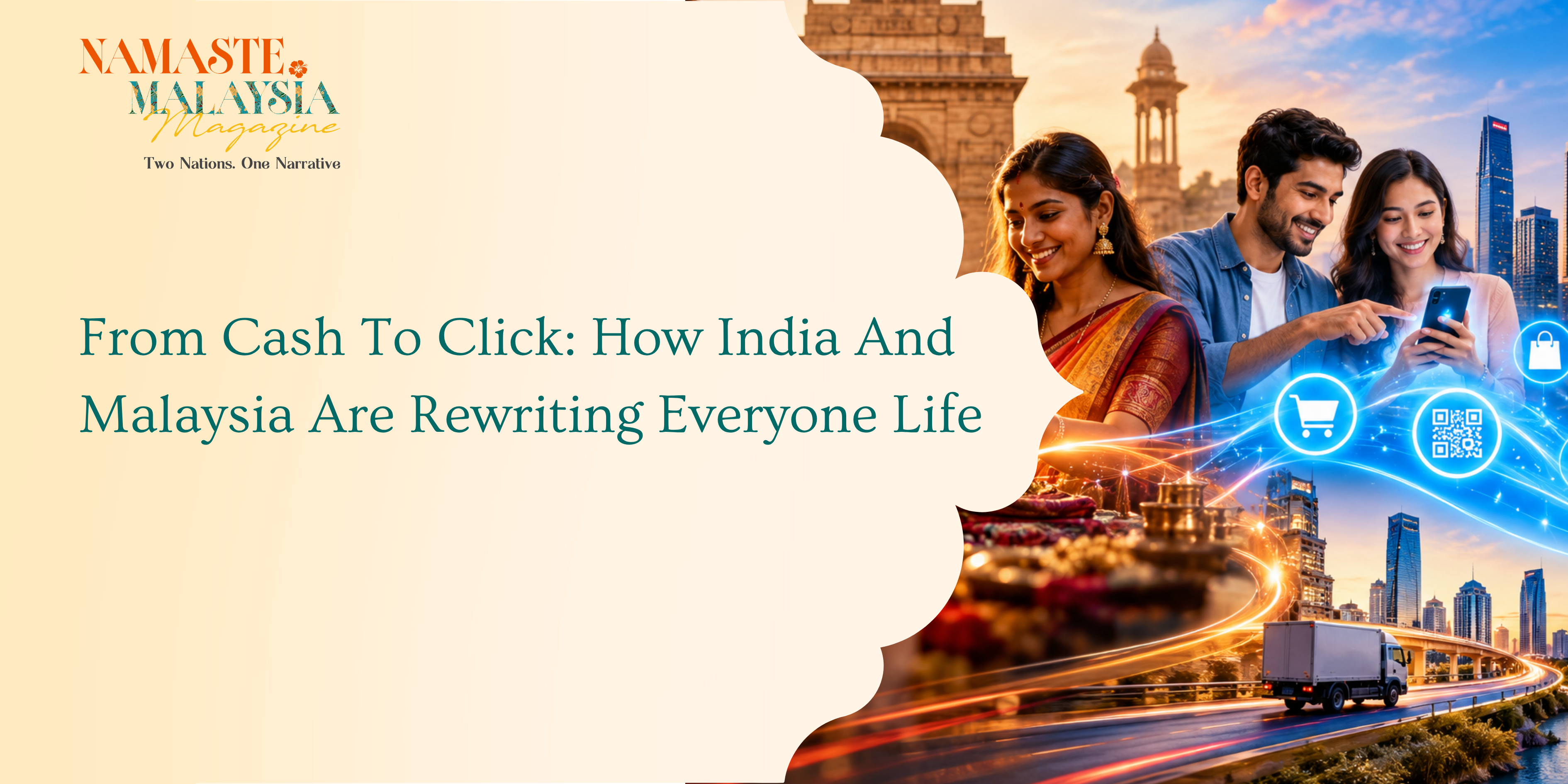
Two countries. Two digital journeys. And a revolution changing how millions of people live, shop and do business.
Remember the days when going shopping meant making sure you had enough cash in your wallet?
You counted the notes, checked your change and sometimes made a trip to the ATM before heading out.
Today, things are rather different.
A cup of coffee? Scan.
Lunch with friends? Scan.
Paying the neighbourhood shopkeeper? Scan.
Sending money to a friend? A few taps and it's done.
In fact, the most frequently asked question at some payment counters is no longer "How much?" but "Can I scan?"
We have moved from counting notes to scanning codes, from queuing at banks to banking on our phones, and from carrying cash to carrying an entire financial ecosystem in our pockets.
India and Malaysia are experiencing this transformation in their own ways. And while their journeys are different, both countries are discovering how technology is changing the everyday experience of money.
INDIA: WHEN A QR CODE BECAME EVERYONE'S CASH REGISTER
Imagine buying a cup of tea from a roadside vendor in India.
You finish your tea, take out your phone, scan a QR code and pay. No cash. No searching for coins. No awkward moment when the vendor says, "Sorry, I don't have change."
This is everyday life for millions of Indians.
At the centre of this transformation is the Unified Payments Interface, better known as UPI.
Launched in 2016, UPI allows people to transfer money instantly between participating bank accounts using mobile applications. It has made digital payments remarkably accessible, whether someone is paying a large electricity bill or buying a small snack.
And the numbers are extraordinary.
According to the India Digital Payments Report 2025 by Worldline, UPI processed 228.5 billion transactions in 2025, representing a 33% increase from the previous year. Its total transaction value reached approximately ₹299.74 trillion.
But the real story is not simply the size of the numbers.
It is where the payments are happening.
From major shopping malls and restaurants to vegetable stalls, roadside tea vendors, taxis and small neighbourhood businesses, QR codes have become a familiar sight.
A street vendor no longer needs a sophisticated cash register to accept digital payments. A small business can participate in the digital economy with a smartphone and the appropriate payment arrangement.
For many ordinary people, this is technology that has become part of daily life.
MALAYSIA: THE RISE OF THE CASHLESS LIFESTYLE
Malaysia has been travelling along its own digital payment journey.
DuitNow QR has become an increasingly familiar feature of the Malaysian shopping experience. Whether buying nasi lemak, paying at a café, shopping at a retail outlet or visiting a pasar malam, customers are increasingly able to make payments simply by scanning a code.
According to Bank Negara Malaysia's 2025 Annual Report, Malaysia recorded 18.4 billion electronic payment transactions in 2025, a 25% increase from 2024.
More impressively, DuitNow QR transaction volume doubled to three billion in 2025, compared with 1.5 billion in the previous year.
By the end of 2025, Malaysia had almost three million registered DuitNow QR touchpoints. A majority were small businesses.
Think about that for a moment.
The neighbourhood stall, the independent retailer and the small home-based business are increasingly part of the same digital payment ecosystem as major shopping centres and established retailers.
For small businesses, digital payments can reduce cash-handling costs and make transactions more convenient. For customers, they offer another way to pay without having to carry physical money.
Malaysia's cashless journey is no longer confined to online shopping or big businesses. It is becoming part of ordinary life.
TWO COUNTRIES, TWO PAYMENT SYSTEMS, ONE EXCITING CONNECTION
Here is where the story becomes particularly interesting.
India has UPI. Malaysia has DuitNow QR.
Both systems have transformed domestic payments, but what happens when people travel between the two countries?
Imagine an Indian tourist visiting Kuala Lumpur.
After a day exploring the city, the tourist stops at a local restaurant, enjoys a meal and is ready to pay. Instead of searching for a currency exchange counter or worrying about carrying enough Malaysian Ringgit, the visitor could use a familiar payment application to scan a supported QR code.
Similarly, imagine a Malaysian travelling to India and being able to pay a merchant using a familiar local banking application.
This is the direction in which the two countries are moving.
In February 2026, Payments Network Malaysia (PayNet) and NPCI International, the international arm of India's National Payments Corporation, signed an agreement to establish cross-border QR payment connectivity.
The initiative is planned in two phases:
- Indian visitors to Malaysia will be able to use UPI-enabled applications at supported DuitNow QR merchants.
- Malaysians visiting India will subsequently be able to scan UPI QR codes using participating Malaysian banking applications or e-wallets.
At the time of writing, the integration was still being prepared for rollout, with no confirmed launch date announced in September 2026.
This is more than a convenience for tourists. It represents a meaningful step towards connecting the everyday financial experiences of two countries.
It could also benefit local merchants, restaurants, retailers and tourism businesses by making it easier for visitors to spend.
Sometimes, stronger international relationships are built not only in boardrooms, but also at the checkout counter.
THE SMALL BUSINESS REVOLUTION: BIG OPPORTUNITIES IN SMALL TRANSACTIONS
Perhaps the most significant impact of digital payments is not being felt by large corporations.
It is being felt by small businesses.
Consider a roadside food seller, a home-based baker, a tailor, a family-run restaurant or a small retail shop.
Traditionally, accepting payments meant handling cash, providing change, keeping records and making regular bank deposits.
Digital payments can simplify some of these processes.
They can also help small businesses:
- Accept payments from customers who prefer cashless transactions.
- Reduce the need to keep large amounts of physical cash.
- Maintain clearer digital transaction records.
- Improve convenience at the point of sale.
- Participate more easily in online and digital commerce.
But there is another benefit worth recognising.
Digital payment records may help some small businesses demonstrate their transaction history when seeking financial services or financing, subject to the requirements of the relevant financial institution.
For entrepreneurs, this is an important development. Technology is not simply making payments faster. It can help businesses become more organised, visible and connected.
BUT IS CASH REALLY DISAPPEARING?
Not quite.
Despite the rapid growth of digital payments, cash still has a place in both countries.
Some people prefer cash. Some businesses operate in areas where digital connectivity is inconsistent. Others may not have smartphones, bank accounts or the confidence to use digital applications.
There are also important concerns about scams, unauthorised transactions, data privacy and cybersecurity.
The convenience of paying with a phone comes with the responsibility of protecting it.
A QR code should not be scanned blindly. Payment details should always be checked before confirming a transaction.
One-time passwords and banking credentials should never be shared with strangers.
And perhaps most importantly, digital progress should not leave anyone behind.
Older people, individuals with limited digital literacy and communities with less access to technology must also be considered as countries move towards increasingly cashless economies.
The objective should not be to eliminate cash at all costs.
It should be to give people more choices, greater convenience and safer ways to manage their money.
WHAT DOES THE FUTURE LOOK LIKE?
The next stage of digital payments will be about much more than scanning QR codes.
Artificial intelligence, digital identity, embedded finance, real-time cross-border payments and new financial technologies are changing how people interact with money.
Imagine a future where travelling between countries does not require worrying about different payment applications, complicated currency exchanges or unfamiliar payment systems.
Imagine small businesses being able to serve international customers as easily as they serve customers from the neighbourhood.
And imagine a small entrepreneur in Malaysia reaching a customer in India without the traditional barriers that once made international business difficult.
Some of these possibilities are already being explored. Others will take time, investment, regulation and public trust to develop.
But one thing is clear: the way we use money is changing, and the pace of change is unlikely to slow down.
THE REAL REVOLUTION IS NOT THE TECHNOLOGY. IT IS THE PEOPLE.
At the end of the day, digital payments are not really about QR codes, applications or sophisticated financial systems.
They are about people.
The mother sending money to her child studying overseas. The small business owner receiving payment without worrying about change. The tourist enjoying a meal in another country without struggling with unfamiliar payment methods. The elderly person learning to use a smartphone for the first time.
These are the everyday experiences that give technology its real meaning.
India and Malaysia may have taken different routes towards digital transformation, but both are moving towards a world where financial services are increasingly accessible, convenient and connected.
And perhaps that is the most interesting part of this story.
We started by asking whether someone had cash.
Now, we simply ask whether they can scan.
The wallet may be getting lighter, but the possibilities are getting bigger.
Note: Have you gone almost completely cashless? Or do you still prefer having notes in your wallet? And if you have travelled between India and Malaysia, what has your experience been with digital payments?
Namaste Malaysia Magazine — connecting people, ideas and opportunities between Malaysia and India, one story at a time.