
India and Malaysia: An Old Friendship, Recalibrated Seven years after a bruising public spat over palm oil and Kashmir, India and Malaysia have rebuilt their partnership around semiconductors, digital payments and the sea lanes that bind them.
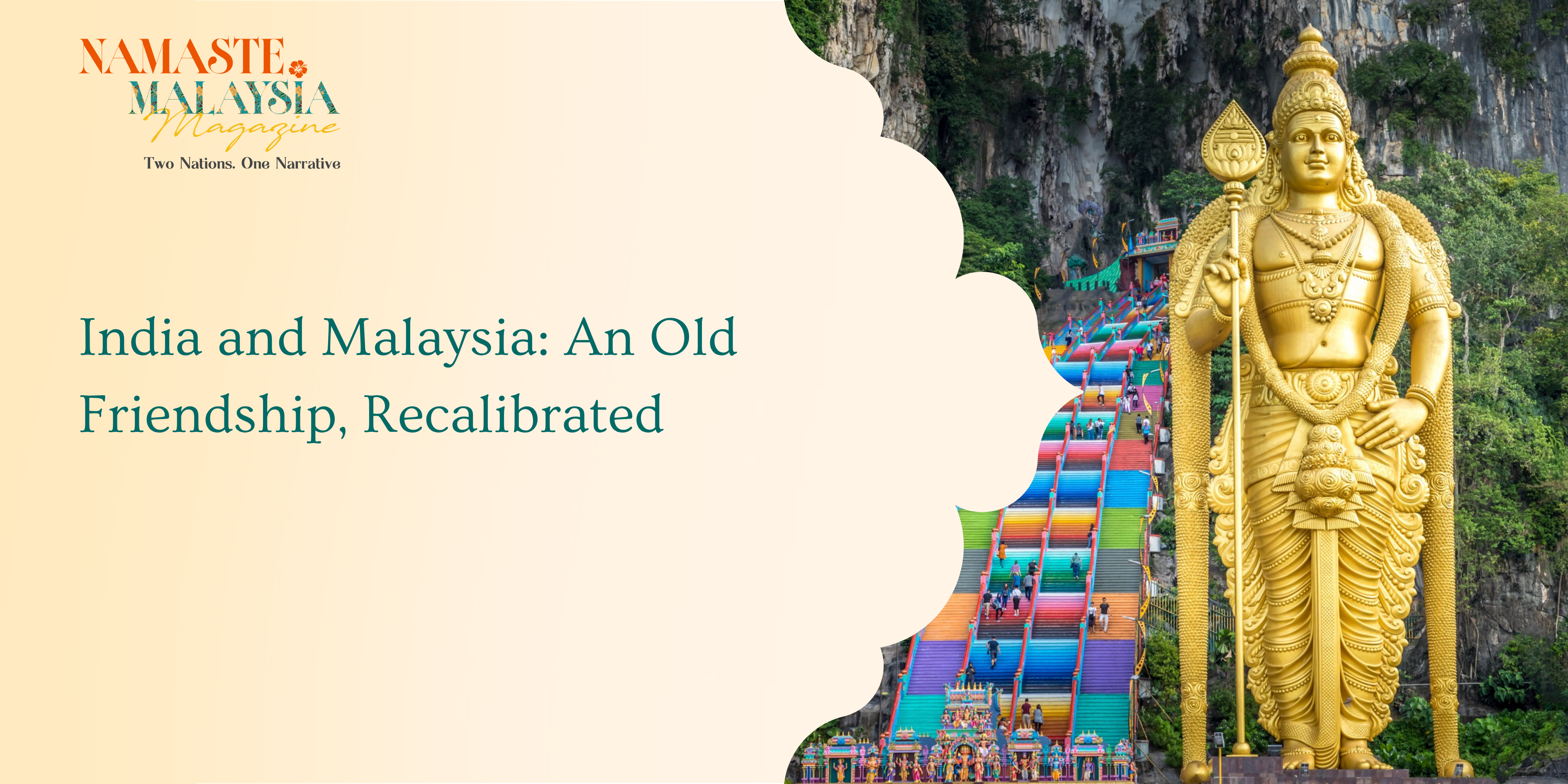
India and Malaysia: An Old Friendship, Recalibrated
Seven years after a bruising public spat over palm oil and Kashmir, India and Malaysia have rebuilt their partnership around semiconductors, digital payments and the sea lanes that bind them. The question now is whether a relationship long defined by what one side buys from the other can become one defined by what they build together.
When Narendra Modi landed in Kuala Lumpur on 7 February 2026, some 15,000 members of the Indian diaspora filled a hall to greet him. He gave the relationship a new slogan, IMPACT, short for "India-Malaysia Partnership for Advancing Collective Transformation. It was his third visit to Malaysia and his first since the two countries raised ties to a Comprehensive Strategic Partnership in August 2024.
The symbolism mattered. Malaysia hosts one of the world's largest populations of Indian origin, sits astride the Strait of Malacca, and is India's third-largest trading partner in ASEAN. Yet for much of the past decade the relationship ran below its potential, and in 2019–20 it briefly ran aground. Today it is one of the steadier bets in India's Act East policy.
Two thousand years of monsoon traffic
The ties predate both nation-states by millennia. Tamil and Kalinga traders rode the monsoon winds to the Malay Peninsula, and the Bujang Valley in Kedah holds the remains of Hindu-Buddhist temples from the first millennium CE. Sanskrit loanwords still run through Bahasa Melayu, and the Chola naval expedition against Srivijaya in 1025 remains a landmark of early Indian Ocean history.
Colonial Malaya added a second layer. The British brought hundreds of thousands of South Indians, mostly Tamils, to work rubber estates, railways and public works. Their descendants form most of today's Malaysian Indian community, roughly 7% of the population. That community gives the relationship an emotional depth few of India's partners can match, and a political sensitivity too.
The palm oil winter of 2019–20
The low point came fast. At the UN General Assembly in September 2019, then-Prime Minister Mahathir Mohamad accused India of having "invaded and occupied" Kashmir, weeks after New Delhi revoked the region's special status. In December he condemned India's Citizenship Amendment Act. New Delhi called the remarks factually inaccurate.
The response was economic. India's Solvent Extractors' Association urged members to stop buying Malaysian palm oil, and in January 2020 the commerce ministry moved refined palm oil and palmolein from the "free" to the "restricted" import list, a step traders read as aimed squarely at Malaysia. India had bought 4.4 million tonnes of Malaysian palm oil in 2019. Mahathir conceded that Malaysia was too small to retaliate. The unresolved request to extradite the preacher Zakir Naik, who has lived in Malaysia since 2016, added to the chill.
The freeze thawed quickly once Mahathir left office in February 2020. Indian refiners resumed buying, and successive governments in Putrajaya chose quiet diplomacy. The episode left two lessons: India will use its buying power when it feels its sovereignty is questioned, and Malaysia's palm oil sector is exposed to swings in Indian demand.
Anwar, Modi and the reset
Anwar Ibrahim's arrival in power in late 2022 gave New Delhi a counterpart who wanted the relationship back on track. His state visit on 20 August 2024, his first to South Asia as prime minister, lifted ties to a Comprehensive Strategic Partnership (CSP). Trade had just hit a record US$19.5 billion, and both sides pledged to speed up the review of the ASEAN- India Trade in Goods Agreement. Malaysia's ISIS think tank called the summit the culmination of a reset that began in 2020.
Modi's return visit on 7–8 February 2026 turned the label into paperwork. The two governments signed or exchanged 11 documents.
- MoUs on anti-corruption and disaster management, and an audio-visual co- production agreement
- A social security arrangement covering Indian workers insured under Malaysia's PERKESO scheme
- Exchanges of notes on semiconductors, healthcare, national security and vocational training
- Renewal of UN peacekeeping cooperation, and Malaysia's ratification of the International Big Cat Alliance
The leaders also formalised a Malaysia-India Digital Council and welcomed a link between India's NPCI International and Malaysia's PayNet, which will let UPI payments work in Malaysia. Malaysia backed India's plan for a consulate in Kota Kinabalu, Sabah.
The pace has held. On 12 September 2026 Anwar was back in New Delhi for the 18th BRICS summit, attending as a partner country, a status Malaysia has held since January 2025. His meeting with Modi centred on turning semiconductor cooperation into industry partnerships and on easing Malaysian exports to India.. Indian reports said Anwar conveyed agreement to the Kota Kinabalu consulate at that meeting.
Palm oil, chips and a stubborn deficit
Trade has plateaued near US$19–20 billion a year, and it tilts heavily toward Malaysia. Bilateral trade reached US$20.01 billion in India's fiscal 2023–24.
Malaysian data put it at RM79.49 billion (US$18.59 billion) in calendar 2025, making India Malaysia's largest trading partner in South Asia. Malaysia is India's third-largest trading partner in ASEAN.
The composition explains the imbalance. In 2024 India exported about US$8.1 billion and imported about US$12.1 billion, a gap of roughly US$4 billion.
| Direction | Top goods, 2024 |
|---|---|
| Malaysia to India | Palm oil (US$2.84 bn), computers, crude petroleum, electronic components |
| India to Malaysia | Refined petroleum (US$2.27 bn), buffalo meat, raw aluminium, machinery |
Palm oil remains the hinge. India is the world's biggest buyer of edible oils, and Anwar used the February summit to pledge that Malaysia would stay a reliable supplier, with new work on downstream palm-based products. New Delhi's frustration lies elsewhere: it wants the long-running review of the ASEAN-India goods agreement (AITIGA) to fix rules of origin and inverted duties that it says hurt Indian manufacturers. The review missed its 2025 target. Its 13th joint committee met in New Delhi in July 2026, co-chaired by India's commerce ministry and Malaysia's trade ministry, and set time-bound deliverables for the outstanding chapters.
The more promising story is technology. Malaysia handles roughly 13% of the world's chip assembly, testing and packaging, while India is subsidising a domestic semiconductor industry. The February exchange of notes on semiconductors, and links between IIT Madras and Malaysia's Advanced Semiconductor Academy, aim to join the two. Energy is a second strand: Petronas and its clean-energy arm Gentari have invested in Indian renewables and green hydrogen. Both central banks now encourage settling trade in rupees and ringgit, and the UPI-PayNet link should lower costs for tourists, students and small firms.
Guarding the Strait
Geography makes Malaysia central to India's maritime interests. A large share of India's eastbound trade passes the Strait of Malacca, and Malaysia's Borneo states face the South China Sea. Both governments insist on freedom of navigation under UNCLOS, while keeping their language on China measured.
Defence ties are practical rather than grand. The two armies held the fifth Harimau Shakti exercise in Rajasthan in December 2025, and the navies meet through Samudra Laksamana, MILAN and the ASEAN-India Maritime Exercise. Indian warships called at Kemaman and Port Klang in 2025. A Su-30 Forum links the Royal Malaysian Air Force, which flies the Russian-built Su-30MKM, with India's large Sukhoi fleet and maintenance base. A new Strategic Affairs Working Group and an inaugural security dialogue add structure.
The two also co-chair the ADMM-Plus counter-terrorism working group for 2024–27, with a tabletop exercise due in Malaysia this year. India's hopes of selling hardware have been harder to realise: Malaysia chose South Korea's FA-50 over India's Tejas for its light combat aircraft in 2023.
The planned consulate in Kota Kinabalu, Sabah, would give India a diplomatic post in Malaysian Borneo, a modest but telling extension of its presence near the South China Sea. At the regional level, India backed Malaysia's 2025 ASEAN chairmanship, and both sides link ASEAN's Indo-Pacific Outlook with India's Indo-Pacific Oceans Initiative. Malaysia, a BRICS partner since January 2025, welcomed India's 2026 BRICS chairmanship and has said it wants full membership.
The living bridge
People, not policy papers, carry most of the relationship. Malaysians of Indian descent number roughly two million, overwhelmingly Tamil, and sustain more than 500 Tamil- medium primary schools, a Tamil press and a festival calendar in which Deepavali and Thaipusam are public holidays in much of the country. Modi used his February visit to stress this shared love of Tamil, and the new Thiruvalluvar Chair and Centre at Universiti Malaya, with scholarships for Malaysians, is aimed squarely at it.
Travel has been the fastest-growing link. Malaysia has let Indians enter visa-free for up to 30 days since December 2023, and extended the scheme to 31 December 2026. Indian arrivals passed one million in the first 11 months of 2024, 47% above 2019 levels. India, for its part, announced free e-visas for Malaysian tourists during the February visit, and Malaysia is pressing for more air traffic rights.
The less glamorous flow is labour. Tens of thousands of Indians work in Malaysian plantations, construction and services, and cases of exploitation and trafficking recur. The February arrangement bringing Indian workers into Malaysia's PERKESO social security system is the most concrete step yet on their protection. Students move both ways, and Malaysia remains a regular user of India's ITEC training programme.
What could still go wrong
The relationship is in its best shape in a decade, but three fault lines remain.
- The balance of trade. A structural deficit of about US$4 billion a year keeps Indian officials sceptical of Malaysian market access. Without a meaningful AITIGA upgrade, trade may keep circling the US$20 billion mark.
- Identity politics. The 2019–20 row showed how fast Kashmir, citizenship law or the treatment of Muslims in India can become a bilateral issue in Muslim-majority Malaysia. The Zakir Naik question has never been resolved, only parked.
- Delivery. Many February commitments are exchanges of notes and working groups. Semiconductor partnerships, the UPI link and the Kota Kinabalu consulate will show whether the CSP produces results or just meetings.
The case for optimism is that interests now align in ways they did not in 2019. Both countries want to hedge in a contest between Washington and Beijing, both seek a bigger voice through BRICS and ASEAN, and both see chips, clean energy and digital payments as the industries that matter next. Anwar has spent political capital on the reset; Modi has now made three visits to Malaysia and hosted Anwar twice in two years. If the next two years move the relationship from buying oil to building chips, the IMPACT slogan may prove more than a clever acronym.
Sources
- India–Malaysia Joint Statement, 8 February 2026 (PMO India)
- Joint Statement on the India–Malaysia Comprehensive Strategic Partnership, August 2024 (PMO India)
- Anwar-Modi BRICS meeting (Malay Mail, 12 September 2026)
- Modi meets Anwar on BRICS sidelines (Dainik Jagran)
- India and Malaysia pledge to bolster trade, defence collaborations (Al Jazeera, February 2026)
- PM Modi's diaspora address in Kuala Lumpur (All India Radio)
- Malaysia's PM defends criticism of India despite palm oil curbs (Al Jazeera, January 2020)
- Pakistan steps in to help Malaysia in palm oil row (Gulf News, February 2020)
- Making the Malaysia-India CSP work (ISIS Malaysia, 2024)
- India-Malaysia trade relations FY2023-24 (ASEAN Briefing)
- India–Malaysia trade profile (OEC)
- 13th AITIGA Joint Committee, July 2026 (IBEF)
- Visa requirements for foreigners (Malaysian High Commission, New Delhi)
- Malaysia extends visa-free entry for Indians (Travel And Tour World)