
Open House, Open Hearts: How Malaysia Made Deepavali Everyone's Festival Walk down any terrace-house street in Klang, Brickfields or Ipoh on Deepavali morning and you will smell it before you see it. Ghee, curry leaves and something frying.
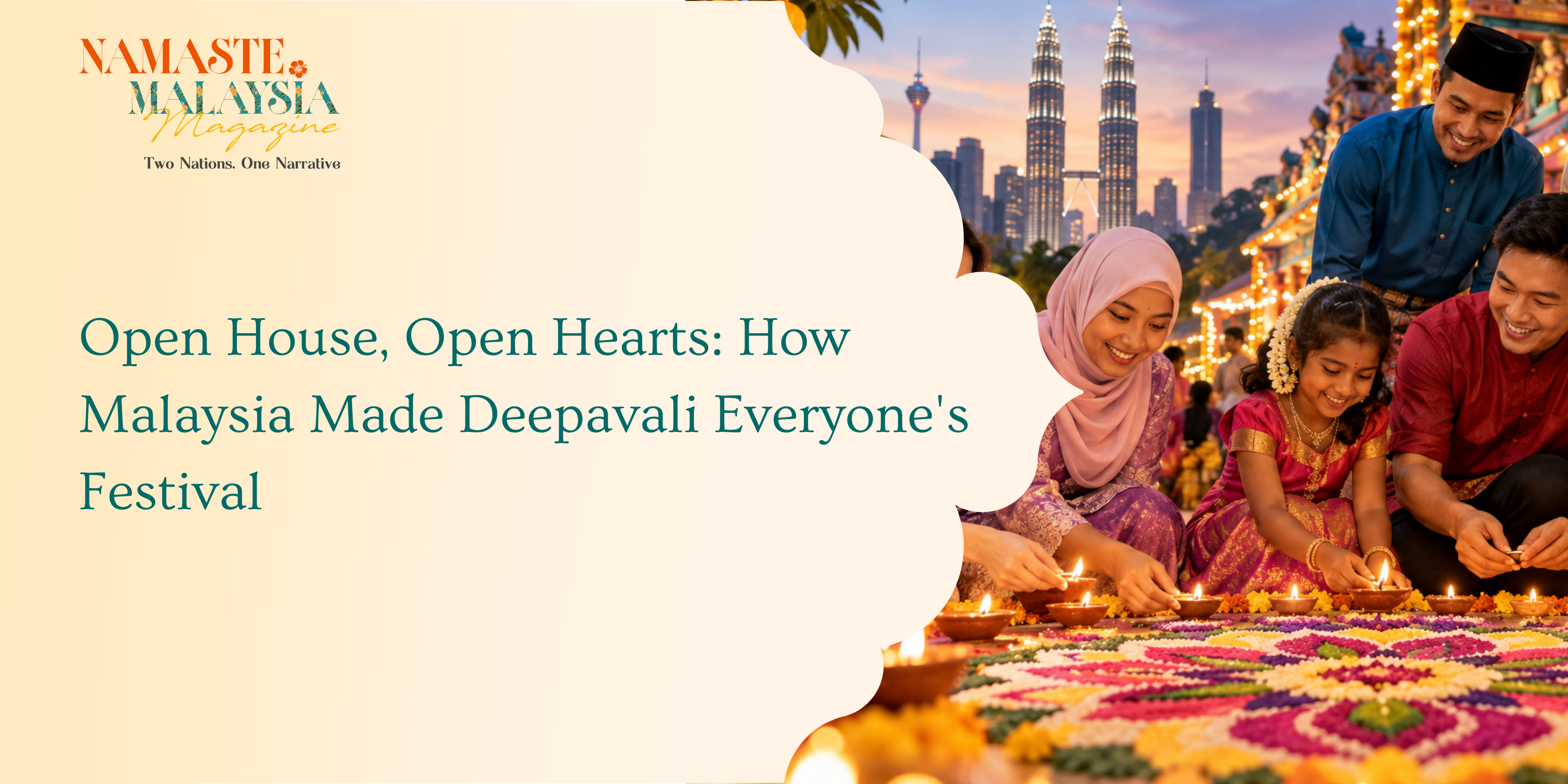
In India, Diwali is a family affair behind closed doors. In Malaysia, the doors are flung open, and the whole neighbourhood walks in. This Deepavali, on Sunday 8 November, here is why that difference matters.
The doors open at ten
Walk down any terrace-house street in Klang, Brickfields or Ipoh on Deepavali morning and you will smell it before you see it. Ghee, curry leaves and something frying.
One house has a kolam of coloured rice flour at the gate and a string of oil lamps along the porch. The shoes outside tell the story. Children's sandals, a pair of office loafers, a woman's heels next to the slippers of a neighbour who came in his baju Melayu.
Inside, a Chinese neighbour is on her second plate of mutton. A Malay colleague is being told, firmly, to take more murukku home. The aunty of the house has not sat down since seven.
Nobody here sent a formal invitation. Nobody needed one. This is the Deepavali open house, and it may be one of the most Malaysian things Malaysia does.
Before the guests: the quiet morning
The open house is the public face of Deepavali. The private part starts long before dawn.
Most Malaysian Indians trace their roots to Tamil Nadu, and the day follows a Tamil rhythm. It begins with the ganga snanam, the ritual oil bath. Elders dab warm sesame oil on each family member's head, sometimes with a pinch of turmeric or shikakai, before everyone bathes. The bath is said to be as purifying as a dip in the Ganges.
Then come new clothes, laid out the night before. A prayer follows at the family altar, and often a visit to the temple. Many families also remember their ancestors, setting out a plate of the dead's favourite foods before anyone else eats.
For newlyweds there is an extra layer. A couple's first Deepavali together, thalai Deepavali, is usually spent at the bride's family home, with gifts and a lot of attention.
Only when all of this is done does the gate open.
The table that never empties
If the morning belongs to the gods and the ancestors, the afternoon belongs to the kitchen.
The cooking starts weeks earlier with the cookies, or palagaram. Every Malaysian Indian household has its tins. There is murukku, the crunchy spiral of rice and urad dal flour, often pressed by hand by three generations around one table. There are athirasam, the dark, chewy jaggery fritters. There are nei urundai, ghee balls that fall apart if you look at them, and ribbon-shaped omapodi.
On the day itself, the main event is meat. Mutton varuval, slow-fried until the spices cling to every piece, is the dish most guests come for. Next to it sit chicken curry, thosai or idiyappam, sambar for the vegetarians, and a pot of rice that somehow never runs out. For dessert there is kesari, the saffron-yellow semolina pudding, and payasam.
Hosts plan the menu around their guests. Hindu households rarely cook beef, and pork is left out so Muslim friends can eat freely. Many families buy from halal caterers or simply cook chicken and mutton, so that no guest has to ask.
Guests rarely arrive empty-handed either. A Malay neighbour may bring a box of kuih. A Chinese family may bring mandarin oranges, a habit borrowed from their own Lunar New Year visits. Food leaves the house the same way it came in: packed in containers, pressed into hands at the door.
Everyone is on the guest list
The open house, or rumah terbuka, is not a Deepavali invention. It is a Malaysian one.
Malay families open their homes for Hari Raya. Chinese families do the same at Lunar New Year. Over the decades, every major festival picked up the same habit. Friends of every faith visit, eat, and are visited back a few months later at their own celebration.
The practice is now so ordinary that it reaches the very top. Ministers, state governments and companies host their own Deepavali open houses, and members of the public queue for a plate.
When festivals have fallen close together, Malaysians have even blended their names: Deeparaya for Deepavali with Hari Raya, Kongsi Raya for Chinese New Year with Hari Raya. The jokes stick because the idea behind them is real. A Malaysian child may eat murukku at Deepavali, ketupat at Hari Raya and pineapple tarts at Chinese New Year, all in one year and all in other people's homes.
Deepavali is a public holiday in every state except Sarawak. With 8 November falling on a Sunday this year, most of the country also gets Monday off. That long weekend is when the visiting really happens.
Same festival, different light
An Indian visitor from Delhi or Lucknow would recognise the lamps in a Malaysian home. Much of the rest might surprise them.
In North India, Diwali runs over five days, from Dhanteras to Bhai Dooj. Its story is Lord Rama's return to Ayodhya after fourteen years in exile. The high point is the evening Lakshmi–Ganesh puja on the new-moon night, when families pray for prosperity and light every diya they own.
Malaysian Deepavali, shaped by Tamil tradition, puts its weight on the morning instead. Its story is Lord Krishna's victory over the demon Narakasura. That is why the oil bath happens before sunrise, and why the Malaysian date can fall a day before the main Diwali night in India.
Neither version is more authentic. One grew in a country where Hindus are the majority and the festival fills the streets. The other grew in a country where Hindus are a minority, and the festival had to make room for everyone at the table.
What the open door says
Deepavali is about light winning over darkness. In Malaysia, that light is also very practical. It is a porch lamp left on so the neighbours know they can come in.
For Indian families who have moved here recently, the open house can feel strange at first. Strangers in the living room, aunties feeding people they met an hour ago. Then it becomes the part they miss most when they go home.
So this weekend, if a colleague says "come by the house on Sunday", go. Take off your shoes, accept the second plate, and leave with more murukku than you can carry. That is how the festival is meant to work here.
First open house? A guest's guide
- Just go. A casual "come by" is a real invitation. Afternoon to early evening is the usual window.
- Shoes off at the door, always.
- Bring something small. A box of kuih, fruit or sweets is plenty. Money is not expected from adult guests.
- Greet with "Happy Deepavali" or "Iniya Deepavali Nalvazhthukkal" if you want to try the Tamil.
- Wear something bright. Black and white are traditionally avoided on festive days.
- Eat, then eat a little more. Refusing the first offer is polite. Refusing the third is nearly impossible.
- Return the favour at your own festival. That is the whole idea.